
Author: Melanie Seabrook
Community Climate Resilience
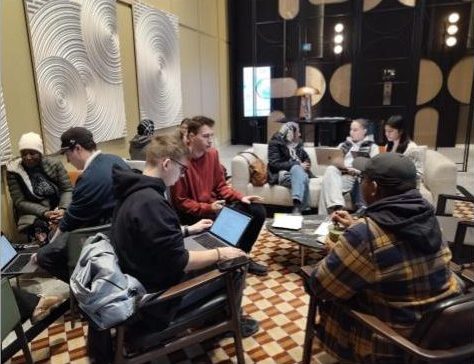
On the morning of March 9th , 2026, CREW volunteers, St. James Town residents, and Toronto Metropolitan University (TMU) students came together at the newly opened Virtu Café located at Bloor and Sherbourne. The group met to learn about local experiences with heatwaves and community climate resilience. They also discussed the power of storytelling in creating change.
For their capstone project in the Environment and Urban Sustainability program, a group of TMU students designed a project. Logan, Megan, Grant, Isabella, Kevin, Quinton, Juli, and Haala worked together on this. They aimed to capture the St. James Town community’s stories in heat resilience, with the help of CREW’s Community Engagement Specialist, Lidia Ferreira.
Interviews
The students interviewed two elders, two mothers, and two youth residents of St. James Town (SJT). Their interviews focused on the effects of extreme heat events on residents and what methods community members use to cope. The responses will be used in a policy report that focuses on the importance of storytelling and community voices in decision-making processes.

The students’ conversations with community members were lively as they shared emotional memories of heatwave impacts on their daily lives. Many residents raised concerns over their neighbours who were older or lived alone. Elders spoke about neighbours helping neighbours as integral to the community, describing how they themselves often check in on their neighbours and offer emotional support. They explained that they put a lot of thought and technique into supporting their fellow community members in compassionate ways. Students listened intently, taking notes.
Students were impressed to learn about how community members were also learning and building local preparedness for extreme weather such as heatwaves, through community support programs and sharing makeshift solutions. Community members draw on their own experiences and skills. They use their work as personal support workers to enhance their preparedness and emergency response practices.

Lessons Learned
Community members were happy to be interviewed by the students and thought they asked good questions. They are passionate about actively participating in improving their neighbourhood and community, stating “if I can help, I will.”
They value how the students made space for them to vent their frustrations with the current state of their living conditions, particularly during emergencies. For instance, residents shared that elevators are perpetually under repairs, and the power is often shut off without warning. Community members appreciate this partnership for linking the SJT community with the academic community. It allows people to share new perspectives. It also enables the analysis of climate issues.

“When people from outside come learn and speak out about our community issues, it means a lot.” – Faiza
The students shared how the amount that they learned from the interviews is “astonishing”. “This project is so much more impactful than writing a basic assignment for class.” – Grant

Outcomes
Reflecting on this collaborative project, Lidia expressed how bringing students and community members together creates a positive learning environment for everyone through the simplicity of social connection.
Anushen, an undergraduate student and long-time volunteer with CREW, feels this meet-up is like a glimpse into his own future. He is pursuing studies in the same program as the TMU students. This learning experience gives him ideas for things he could do in the future to continue supporting CREW. Hina, also an undergraduate student from SJT and CREW volunteer, sees connecting with upper-year students as an opportunity for mentorship too.
Lidia shares that her underlying goal with this work is to support youth in developing the skills and knowledge they need in order to become leaders in community climate resilience. Her success is clear. Students and community members alike left feeling inspired by their new connections and were moved by the stories they heard. Multiple students even expressed interest in volunteering with CREW!


Published by